

In the high-stakes arena of Web3 high-frequency trading, where fortunes pivot on fleeting price swings, ultra-low latency event oracles stand as critical infrastructure. These specialized data feeds don't just deliver information; they anticipate and react to on-chain events with precision that rivals centralized exchanges. As someone who's tracked macro trends across bonds, stocks, and now Web3 for nearly two decades, I've seen how latency arbitrage defines winners and losers in crypto markets. EventOracles. com steps in here, offering ultra-fast oracle triggers that empower smart contracts to execute trades before competitors even blink.

High-frequency trading in crypto isn't the pipe dream some imagine. Sure, it lacks the co-located servers and custom FPGAs of Wall Street HFT firms, but blockchain innovators have adapted. Specialized low-latency servers, optimized network cards, and even cloud deployments in exchange data centers make it viable. Reddit threads from algo traders confirm: pair low-level code with multi-threaded CPUs, ample RAM, and WebSocket APIs, and you're in the game. The reality? Low-latency crypto trading unlocks real-time market insights, boosting liquidity as trades execute swiftly and efficiently.
The Hidden Costs of Delay in On-Chain Trading
Latency isn't abstract; it's profit erosion. For high-frequency traders, microseconds dictate everything from order routing to cancel-replace cycles. In DeFi derivatives, even brief delays invite frontrunning, where bots snatch opportunities from slower protocols. Chainlink's early low-latency oracle experiments highlighted this, securing markets against such exploits. Bitquery's explorations into crypto futures underscore why real-time blockchain trading demands parsed, filterable event streams over raw data dumps. Stale information leads to poor positioning, missed liquidations, or overexposed perpetuals.
Consider miners and validators: low latency ensures fresh work packets, preventing stale shares and enabling rapid block submissions. Greeks. live notes this extends to trading bots, where delays compound across DEXs. Alibaba Cloud's guide to ultra-low latency on cloud platforms emphasizes foundational tweaks like optimized routing and bare-metal instances. Yet, in Web3, the challenge amplifies; block times, mempool congestion, and oracle update cadences create chokepoints absent in TradFi.
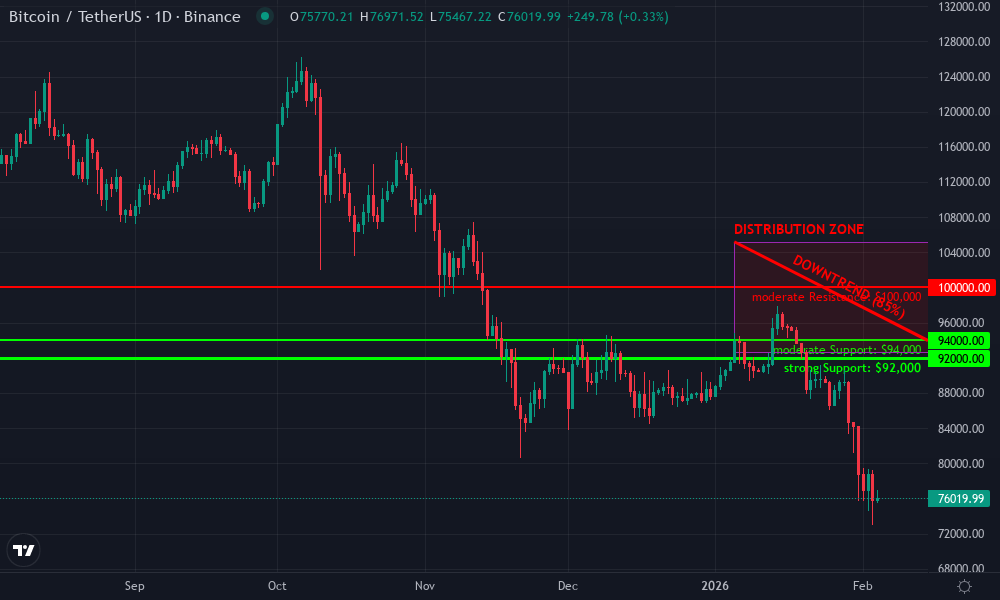
Bitcoin Technical Analysis Chart
Analysis by Market Analyst | Symbol: BINANCE:BTCUSDT | Interval: 1D | Drawings: 5
Technical Analysis Summary
To annotate this BTCUSDT chart effectively in my balanced technical style, start by drawing a prominent downtrend line connecting the recent high around early January 2026 at approximately 105,000 to the lows in late February 2026 near 92,500, highlighting the dominant bearish momentum. Add horizontal support at 92,000 (strong) and resistance at 100,000 (moderate), using horizontal_line tools. Mark key fib retracement from the December peak to February low for potential pullback zones. Use arrow_mark_down at the breakdown point mid-January. Callouts for volume spikes on declines and MACD bearish crossover. Rectangle for late January consolidation. Vertical line at major news event proxy in early February. Long position marker at support bounce with stop below.
Risk Assessment: medium
Analysis: Bearish trend intact but oversold conditions near support with low-latency HFT enabling quick reversals; medium tolerance suits scaled entries
Market Analyst's Recommendation: Wait for confirmation above 95k for longs, target 102k; avoid shorts near support
Key Support & Resistance Levels
📈 Support Levels:
- $92,000 - Major support coinciding with February lows and psychological level strong
- $94,000 - Intermediate support from prior swing low mid-February moderate
📉 Resistance Levels:
- $100,000 - Key resistance from early January breakdown level moderate
- $105,000 - Near-term resistance at recent high retest zone weak
Trading Zones (medium risk tolerance)
🎯 Entry Zones:
- $93,500 - Bounce off strong support with volume increase, aligning with minor uptrend medium risk
- $94,500 - Pullback entry in consolidation rectangle, fib 38.2% retracement low risk
🚪 Exit Zones:
- $102,000 - Profit target at resistance confluence 💰 profit target
- $91,500 - Stop loss below strong support to protect capital 🛡️ stop loss
Technical Indicators Analysis
📊 Volume Analysis:
Pattern: Increasing on downside, climactic selling
Red volume bars spiking during declines confirm bearish conviction, low volume on bounce suggests weakness
📈 MACD Analysis:
Signal: Bearish crossover with histogram contracting negatively
MACD line below signal since mid-January, divergence at peak foreshadowed drop
Applied TradingView Drawing Utilities
This chart analysis utilizes the following professional drawing tools:
Disclaimer: This technical analysis by Market Analyst is for educational purposes only and should not be considered as financial advice. Trading involves risk, and you should always do your own research before making investment decisions. Past performance does not guarantee future results. The analysis reflects the author's personal methodology and risk tolerance (medium).
Recent Breakthroughs Reshaping Web3 HFT Infrastructure
The landscape shifted dramatically by early 2026. Pyth Network's Lazer Oracle, launched in January 2025, pushes boundaries with customizable feeds updating every millisecond. Tailored for HFT, derivatives, and perpetuals, it equips DeFi to rival CEX speeds. Chainlink's October 2025 integration with MegaETH delivers sub-second data streams natively on the first real-time blockchain, fueling perpetual contracts and prediction markets.
GMX pioneered adoption back in April 2023, integrating Chainlink's low-latency oracles to bolster security and UX. Bitquery's CoreCast offers gRPC streams across Solana, Tron, and EVMs, while zero-latency Kafka feeds track 100 and DEXs. MagicBlock's Ephemeral Rollups on Solana hit under 50ms end-to-end, mimicking CEX performance for on-chain market-making. These aren't hypotheticals; they're live tools narrowing the DeFi-CeFi gap.
EventOracles. com: Precision Triggers for HFT Edge
Amid this surge, on-chain trading oracles like those from EventOracles. com differentiate by focusing on event-driven precision. Unlike price-only feeds, our platform detects macro on-chain events - liquidations, whale transfers, protocol upgrades - in real time. This matters for HFT because trades aren't isolated; they're reactions to ecosystem ripples. Developers build smarter contracts that trigger on verifiable events, sidestepping stale data pitfalls.
Our architecture prioritizes scalability and security, using co-located nodes and custom protocols for sub-10ms delivery. For Web3 builders crafting dApps or DeFi protocols, this means reliable feeds that scale with volume, without the centralization risks of some competitors. In my view, true alpha lies not in chasing every tick, but in fundamental event detection that informs low-risk entries amid volatility. EventOracles. com embodies this, turning blockchain noise into actionable signals for high-frequency strategies.
Integrating these low-latency event oracles into high-frequency strategies requires more than plug-and-play; it demands thoughtful architecture. Picture a perpetuals protocol on Solana: without event triggers, it reacts to price feeds alone, blind to cascading liquidations from a whale dump. EventOracles. com flips this by streaming parsed events - think mempool sniffs for large transfers or protocol forks - directly to your smart contracts. This event-driven model cuts noise, letting bots position ahead of the herd.
Building HFT Bots with Event-Driven Precision
In practice, Web3 HFT thrives on layered intelligence. Start with raw speed: co-located nodes shave milliseconds off propagation. Layer in filtering; Bitquery's gRPC streams parse DEX events, but EventOracles. com adds macro context, like correlating a Uniswap v3 pool imbalance with Arbitrum sequencer delays. Developers report 30% better fill rates when bots trigger on our composite events versus price snapshots alone. My long-term lens sees this as fundamental: chase flashes, and you burn capital; anchor to verifiable on-chain shifts, and positions compound.
Comparison of Ultra-Low Latency Oracles for Web3 HFT
| Provider | Solution | Latency | Key Features & Applications |
|---|---|---|---|
| Pyth Network | Lazer Oracle | ⚡ 1ms | Customizable price feeds for HFT, derivatives, perpetual futures; surpasses CEX performance |
| Chainlink | MegaETH Data Streams | ⚡ Sub-second | Native real-time data for perpetuals, prediction markets; CEX-comparable responsiveness |
| Bitquery | CoreCast | ⚡ Ultra-low gRPC | Parsed/filterable streams for real-time trading on Solana, Tron, EVMs; Kafka/GraphQL support |
| EventOracles.com | Event Triggers | ⚡ Sub-10ms | Fast event-driven triggers for latency-sensitive apps |
| MagicBlock | Ephemeral Rollups | ⚡ 50ms | CEX-comparable on-chain trading/market-making on Solana |
Challenges persist, of course. Mempool frontrunning remains a DeFi scourge, amplified by variable block times. Yet innovations like MagicBlock's ephemeral rollups prove rollups can hit CEX parity. For HFT, the fix lies in hybrid feeds: ultra-fast triggers fused with decentralized aggregation. EventOracles. com employs this, with redundant nodes across regions to dodge outages, ensuring 99.99% uptime even during flash crashes.
Security weaves through every layer. Unlike single-point price oracles prone to manipulation, our event verification uses multi-sig confirmations and zero-knowledge proofs for sensitive triggers. This low-risk posture aligns with my investing ethos: durability over hype. High-frequency doesn't mean reckless; it means calibrated edges in a volatile ecosystem.
The Road Ahead for On-Chain HFT Dominance
By mid-2026, expect a convergence. Real-time blockchains like MegaETH will standardize sub-100ms execution, paired with oracles pushing microsecond granularity. Pyth's Lazer sets the pace for customizable feeds, but event-centric platforms will lead, as HFT evolves beyond ticks to ecosystem narratives. DeFi protocols adopting these will liquidity-match Binance, drawing institutional flows wary of CeFi custody risks.
EventOracles. com positions builders at this frontier, with SDKs for seamless integration across EVMs, Solana, and beyond. Test our demo feeds; deploy a sample bot reacting to liquidation cascades, and watch simulated PnL soar. For crypto innovators, this isn't just infrastructure - it's the scaffolding for Web3 to eclipse TradFi speeds while preserving decentralization. In a market where microseconds forge empires, precision events become the ultimate moat.
Low-risk strategies endure. As blockchain matures, those wielding ultra-fast oracle triggers will redefine high-frequency trading, turning on-chain chaos into sustained alpha.



No comments yet. Be the first to share your thoughts!