Defining event-driven oracles
Traditional oracles operate on a pull-based model, where a smart contract periodically requests the latest price or data point from an external source. This approach introduces latency and potential gaps in data availability, particularly during periods of high volatility. Event-driven oracles solve this by pushing data to the blockchain only when specific conditions or thresholds are met, ensuring that smart contracts receive updates in real-time without unnecessary gas costs or stale information.
In this architecture, the oracle acts as an active participant rather than a passive responder. Instead of waiting for a contract to ask for a price, the oracle monitors external data feeds—such as financial markets, weather sensors, or sports results—and triggers a transaction the moment a significant change occurs. This shift from polling to event-driven triggers reduces latency significantly, allowing DeFi protocols to react instantly to market movements.
The mechanism relies on event handlers that subscribe to specific data streams. When the underlying data changes, the handler generates an event that propagates through the system, updating the relevant smart contracts. This model is particularly valuable for applications requiring high-frequency updates, such as automated liquidations in lending protocols or real-time derivatives pricing, where even a few seconds of delay can result in significant financial loss.
How real-time data flows through the system
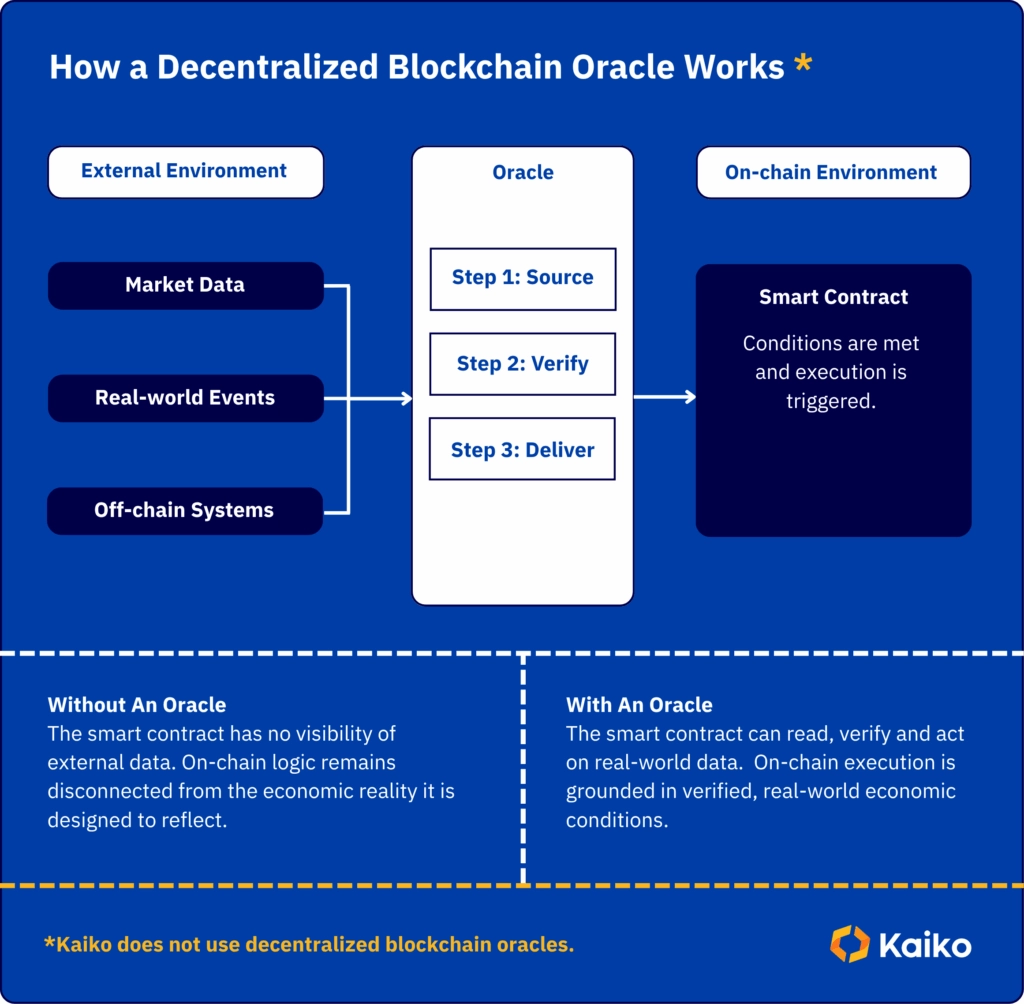
Traditional oracles rely on pull models or scheduled updates, creating latency that can be exploited in volatile markets. Event-driven oracles change this by reacting to data changes the moment they occur. This architecture allows smart contracts to execute logic—such as liquidations or price adjustments—without manual triggers or polling loops, ensuring the blockchain state always reflects the current market reality.
The process begins with data sources generating events. When an external feed, such as a cryptocurrency exchange or weather service, detects a change, it emits an event message. This message is picked up by an oracle node, which validates the data and signs a transaction. This signature proves the data came from a trusted source and hasn't been tampered with during transit. The transaction is then broadcast to the blockchain network.
Once the transaction is confirmed, the smart contract consumes the event. The contract does not need to actively ask for the price; it simply listens for the incoming event. When the event arrives, the contract’s internal logic automatically updates its state variables. This passive consumption model reduces gas costs and eliminates the risk of stale data being used for critical financial operations.
Enabling Smart Contract Automation
Event-driven oracles shift DeFi infrastructure from passive polling to active reaction. Instead of a contract periodically asking, "What is the price?", the oracle pushes the data the moment a significant change occurs. This reduces latency, cuts down on unnecessary gas costs, and allows protocols to execute complex logic based on real-world triggers rather than stale snapshots.
Liquidation Engines
The most critical use case for this architecture is automated liquidation. In lending protocols like Aave or Compound, collateral must be maintained above a specific health factor. If the value of that collateral drops below the threshold, the position becomes under-collateralized.
With event-driven oracles, the protocol receives an immediate alert the moment the price feed crosses the liquidation boundary. This allows liquidators to trigger the liquidation transaction within seconds, often before a human could even refresh their dashboard. This speed is essential to protect the solvency of the lending pool and minimize the loss of funds for other users.
Automated Market Making (AMM) Rebalancing
Event-driven feeds also power more sophisticated DeFi primitives beyond simple lending. Automated Market Makers (AMMs) can use real-time price updates to trigger internal rebalancing strategies or dynamic fee adjustments.
For example, if a token experiences a sudden, high-volume spike, an event-driven oracle can notify the AMM contract to temporarily widen spreads or shift liquidity. This prevents arbitrageurs from draining the pool during periods of high volatility. By reacting to market events in real-time, these protocols maintain tighter price accuracy and reduce impermanent loss for liquidity providers.
Event-driven vs orchestration models
DeFi protocols often conflate event-driven architectures with orchestration, but they serve distinct roles in real-time data pipelines. Understanding the difference is critical for building reliable, low-latency oracle systems. One approach handles the flow; the other handles the trigger.
Event-driven architectures act as the nervous system. They rely on asynchronous messages—events—that propagate state changes across the network. In DeFi, this means a smart contract emits an event when a price feed updates, and interested subscribers react immediately. This model excels at decoupling components, allowing the price aggregator to update without waiting for the lending protocol to process the change. It is ideal for real-time data feeds where speed and responsiveness matter more than strict sequence.
Orchestration, by contrast, is the central conductor. An orchestrator manages the entire workflow, dictating the order of operations and handling errors explicitly. If a DeFi protocol requires a multi-step transaction—such as checking a price, verifying collateral, and then executing a liquidation—orchestration ensures each step completes before the next begins. It provides control and predictability, but at the cost of latency and complexity. The orchestrator becomes a single point of failure if not designed for high availability.
The choice depends on your data needs. Use event-driven models for continuous, real-time updates like price feeds or liquidation triggers. Use orchestration for complex, multi-step transactions that require strict ordering and error handling. Many advanced systems combine both: orchestration manages the high-level workflow, while event-driven communication handles the real-time data exchange between services. This hybrid approach balances the responsiveness of events with the control of orchestration, creating a robust foundation for DeFi applications.
No comments yet. Be the first to share your thoughts!