What event-driven oracles do
Event-driven oracles represent a fundamental shift in how smart contracts access external information. Traditional oracle models typically rely on polling, where a contract or a watcher periodically checks a data source for updates. This approach is inherently passive and often introduces latency or unnecessary gas costs, as the contract must constantly query whether anything has changed.
An event-driven oracle operates differently. Instead of waiting for a request, the oracle listens for specific data events—such as a price update, a transaction confirmation, or a weather threshold being crossed—and pushes that information to the blockchain only when it occurs. This transforms the data feed from a static query into an active, real-time notification system. The oracle acts as a bridge, capturing external occurrences and translating them into on-chain signals that smart contracts can immediately process.
This architecture enables true automation. For instance, a decentralized insurance contract doesn't need to poll weather APIs every hour to check for a storm. Instead, it waits for the oracle to emit an event confirming a hurricane has been recorded. Once that event is received, the contract automatically triggers the payout logic. This reduces reliance on continuous monitoring and ensures that actions are taken precisely when the underlying conditions are met, rather than on an arbitrary schedule.
By decoupling data availability from contract execution, event-driven oracles allow for more complex, responsive decentralized applications. They support asynchronous workflows where the timing of an action depends on real-world events rather than block intervals, creating a more efficient and accurate integration between off-chain reality and on-chain code.
Polling versus event-driven architectures
Traditional oracle solutions often rely on polling, where smart contracts or off-chain services repeatedly query a data source at fixed intervals to check for updates. This approach is simple to implement but inefficient. It consumes gas on every request, regardless of whether the underlying data has actually changed, and introduces latency between the real-world event and its on-chain representation. For time-sensitive DeFi applications, this delay can result in stale prices or missed opportunities.
Event-driven architectures address these inefficiencies by shifting from a "pull" model to a "push" model. In this system, an external oracle monitors real-world data sources and emits an event only when a significant change occurs. Smart contracts subscribe to these events and execute logic immediately upon receipt. This ensures that the blockchain state reflects real-world conditions with minimal delay, reducing unnecessary network congestion and gas costs.
The difference is comparable to checking a mailbox every hour versus having the postman deliver mail directly to your door. Polling requires constant effort and resources to find updates, while event-driven delivery brings the information to you only when it arrives.
| Metric | Polling | Event-Driven |
|---|---|---|
| Gas Cost | High (repeated queries) | |
| Gas Cost | Low (on-change only) | |
| Latency | High (interval-dependent) | |
| Latency | Low (near real-time) | |
| Data Freshness | Stale between polls | |
| Data Freshness | Always current | |
| Complexity | Simple implementation | |
| Complexity | Requires event listeners |
Key components of an oracle network
An event-driven oracle network functions as a pipeline, moving information from the outside world into a blockchain. This architecture relies on three distinct layers: data sources that generate raw information, event brokers that manage the flow, and smart contract interfaces that execute the logic. Understanding how these pieces interact explains why this model is faster and more efficient than traditional polling systems.
Data sources
Data sources are the entry points where real-world information originates. These can be centralized APIs, IoT sensors, or other blockchains. In an event-driven system, these sources do not wait to be asked for data; they emit events whenever a state change occurs. For example, a weather station emits a data point only when temperature readings shift significantly. This reduces network congestion and ensures the oracle network processes only relevant, timely information.
Event brokers
Event brokers act as the traffic controllers of the network. They receive the raw events from data sources and route them to the appropriate oracle nodes. Brokers handle message queuing, ensuring that no data is lost during high-volume periods. They also validate the format of incoming events, acting as a filter before the data reaches the consensus layer. This separation of concerns allows the oracle network to scale horizontally, handling thousands of concurrent data streams without bottlenecking.
Smart contract interfaces
The final component is the interface layer that connects the oracle network to the blockchain. Smart contracts use these interfaces to subscribe to specific data streams. When an oracle node confirms a value, it calls a function on the smart contract, updating the on-chain state. This interaction is atomic and trustless. The interface defines the standard format for data submission, ensuring that different oracle providers can feed data into the same contract without compatibility issues.
Real-world DeFi use cases
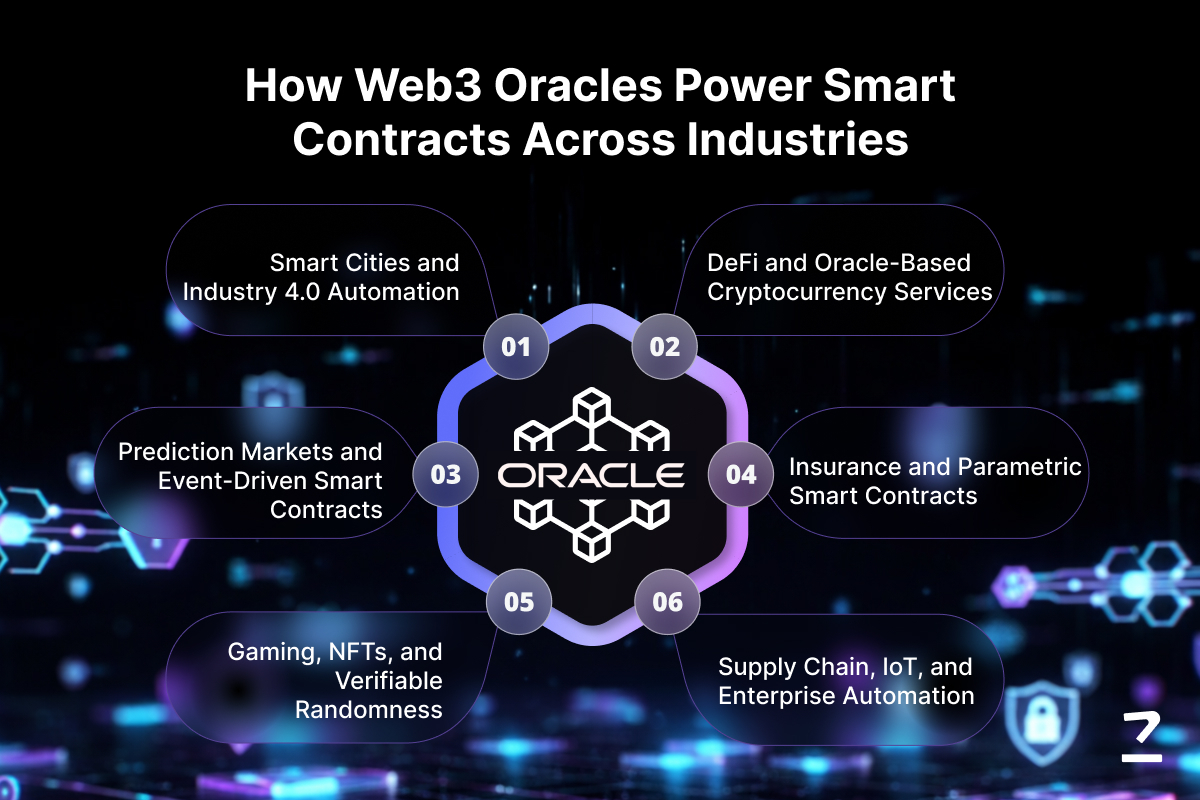
Event-driven oracles transform smart contracts from static ledgers into active participants in the financial system. By reacting to specific triggers rather than polling for data, these oracles enable protocols to execute complex financial logic with minimal latency and reduced gas costs. The following examples illustrate how this architecture underpins modern decentralized finance.
Lending protocols
In lending markets like Aave or Compound, event-driven oracles provide a continuous stream of asset prices and health factors. Instead of requiring users or the protocol to manually check if a loan is undercollateralized, the oracle emits a price update event whenever market conditions shift. The smart contract listens for this event and automatically adjusts collateral requirements or triggers liquidations if the borrower’s position falls below the safety threshold. This real-time feedback loop ensures that the protocol remains solvent even during periods of extreme market volatility, preventing the kind of cascading failures seen in earlier generations of DeFi.
Automated market makers
Automated market makers (AMMs) rely on accurate, timely price feeds to maintain their pricing curves. Event-driven oracles feed price data directly into the AMM’s swap logic, allowing the protocol to adjust token reserves dynamically as external market prices change. This reduces the risk of arbitrage opportunities that drain liquidity from the pool. When a significant price event occurs on a centralized exchange, the oracle detects the shift and updates the on-chain price, ensuring that the AMM’s internal pricing remains aligned with the broader market. This synchronization is critical for maintaining deep liquidity and fair pricing for traders.
Cross-chain bridges
Cross-chain bridges must verify the state of assets on remote blockchains to release corresponding tokens on the destination chain. Event-driven oracles monitor these remote chains for specific transaction events, such as a token deposit or a minting action. Once the oracle confirms the event has been validated by a network of nodes, it triggers the release of assets on the target chain. This approach eliminates the need for constant polling of remote block states, significantly reducing the computational overhead and latency associated with cross-chain transfers.
The Reliability Gap
Even the most sophisticated smart contracts are only as secure as the data they consume. When an oracle acts as a single point of failure, it creates a critical vulnerability that attackers can exploit. If a centralized service is compromised or experiences downtime, the entire downstream system collapses, regardless of how robust the underlying blockchain logic is.
Event-driven architectures attempt to mitigate this by reacting to real-time changes rather than polling static values. However, without a decentralized oracle network, these events can still be manipulated or delayed. A malicious actor controlling the data feed can trigger false conditions, leading to incorrect contract executions or financial losses.
Decentralized oracle networks distribute data sources across multiple nodes, making it significantly harder for bad actors to manipulate the input. This redundancy ensures that the smart contract receives accurate, tamper-resistant information, preserving the integrity of the event-driven workflow.
No comments yet. Be the first to share your thoughts!