What event-driven oracles are
An event-driven oracle acts as a bridge between off-chain data sources and on-chain smart contracts, but it operates on a fundamentally different trigger mechanism than traditional polling systems. Instead of a contract repeatedly asking, "What is the current price?" at fixed intervals, the oracle listens for specific state changes in the external world and pushes the new data only when it matters.
Think of this like a doorbell versus a security guard. A polling system is like a guard who walks to the door every five minutes to check if anyone is there. An event-driven oracle is the doorbell: it stays silent until a physical event (a press) occurs, then immediately alerts the system. This shift from "pull" to "push" reduces latency and eliminates redundant queries that waste gas and processing power.
In practice, this means the oracle subscribes to webhooks, blockchain logs, or message queues. When an external service emits a signal—such as a shipment status update or a financial trade execution—the oracle validates the payload and writes the result to the blockchain. This approach ensures that smart contracts react to real-time events with minimal delay, making them suitable for high-frequency trading, dynamic insurance payouts, and automated supply chain tracking.
Orchestration versus event-driven design
Choosing between orchestration and event-driven patterns depends on how your system handles state and coupling. Orchestration centralizes control, while event-driven design distributes responsibility across independent services. Understanding these differences helps you select the right architecture for Oracle Integration and other microservice environments.
Centralized orchestration
In an orchestration model, a central controller directs the flow of execution. This pattern ensures strict ordering and simplifies debugging because every step is managed by a single entity. It works well for linear workflows where consistency matters more than speed.
Decentralized event-driven communication
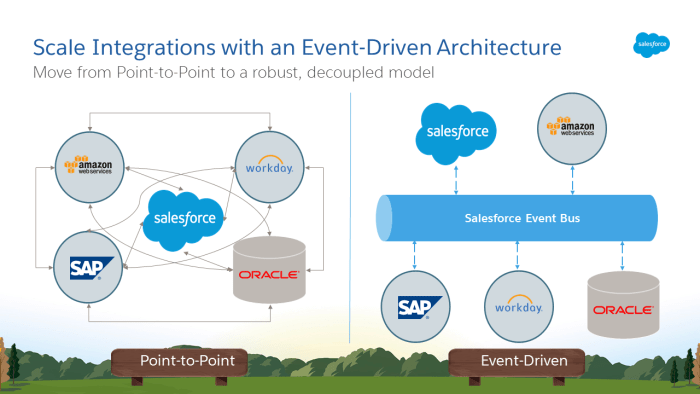
Event-driven systems rely on asynchronous messages. Services publish events without knowing who will consume them. This loose coupling allows components to scale independently and react to changes in real time, making it ideal for complex, distributed architectures.
Comparison of patterns
Use the table below to compare the core characteristics of each approach.
| Pattern | Coupling | Flow | Scalability |
|---|---|---|---|
| Orchestration | Tight | Linear | Limited by central controller |
| Event-driven | Loose | Asynchronous | Highly scalable |
Setting up triggers in Oracle Integration
Event-Driven Oracles works best as a sequence, not a scramble through settings. Do the minimum first: confirm compatibility, connect the core hardware, update only when needed, and test the result before adding optional features. That order keeps the task understandable and makes failures easier to isolate. After each step, pause long enough for the interface to finish syncing. Many setup problems are timing problems disguised as configuration problems. If the same step fails twice, record the exact error, restart the smallest affected piece, and retry before moving deeper.

Common integration mistakes to avoid
Event-Driven Oracles troubleshooting should start with a clear boundary: what is actually broken, and what still works normally. Check the display, network connection, paired devices, app access, and recent updates before assuming the whole system needs a reset. A small connection failure can make the main screen feel unreliable even when the core system is fine. Work from low-risk checks to deeper resets. Confirm power state, safe parking, account access, and signal first. Then restart the interface, wait for it to reload completely, and test the original symptom. Avoid changing multiple settings at once because that makes it harder to know which step actually fixed the problem. If the issue affects safety information, repeats after every restart, or appears with warning messages, treat the reset as a temporary diagnostic step rather than the final fix. Document the symptom and move to official support instead of stacking more DIY attempts.
The simplest way to use this section is to keep the setup small, verify each change, and record the stable configuration before adding optional accessories.
Event-driven design versus domain-driven design
Event-driven design (EDD) and domain-driven design (DDD) address different layers of system architecture. EDD focuses on how components communicate asynchronously through events, while DDD centers on modeling complex business logic within bounded contexts. They are not competing paradigms but complementary tools for building scalable systems.
EDD provides the communication backbone. It enables loose coupling between services, allowing them to react to state changes without direct knowledge of each other. This is essential for real-time updates and reactive applications. DDD, on the other hand, ensures that the internal logic of each service remains aligned with business terminology and rules.
In Oracle Integration, this combination proves powerful. You use DDD to define clear bounded contexts for your business processes. Then, you use EDD to trigger those processes across services via events. This separation allows teams to evolve business logic independently of the integration layer. The result is a system that is both flexible in communication and precise in business logic.
Think of DDD as the blueprint for each room in a house, defining its purpose and structure. EDD is the electrical wiring that connects those rooms, allowing signals to travel between them. Both are necessary for a functional home.
No comments yet. Be the first to share your thoughts!