What event-driven oracles do
Traditional oracles typically function as pull-based data feeds, delivering static information like price ticks or weather reports when a smart contract explicitly requests it. Event-driven oracles change this dynamic by acting as reactive bridges. They continuously monitor external systems for specific state changes and push those updates to blockchain networks or AI agents only when a predefined condition is met.
This architecture relies on event handlers and triggers rather than periodic polling. When an external event occurs—such as a sensor detecting a threshold breach or a database record being updated—the oracle captures the event and initiates a cryptographic verification process. This reduces latency significantly compared to polling models, where agents must constantly check for new data, often missing real-time windows or incurring unnecessary gas costs.
The mechanism mirrors how Oracle Cloud Infrastructure (OCI) handles resource changes. In OCI, services emit structured events indicating resource modifications, which administrators can then track via rules. Similarly, event-driven oracles listen for these structural shifts in the real world. Once verified, the event is transformed into a cryptographically signed trigger that AI agents or smart contracts can consume immediately.
For AI agents, this shift from pull to push is foundational. It allows agents to react to real-world stimuli in near real-time, enabling workflows that were previously impossible due to the lag inherent in static data feeds. The oracle becomes the nervous system, translating external chaos into structured, actionable on-chain signals.
How real-time triggers work
Event-driven oracles replace manual polling with continuous, low-latency monitoring. Instead of an AI agent periodically asking for the latest data, the oracle detects an event and pushes the update immediately. This mechanism uses event handlers to listen for state changes in external systems or blockchain networks.
The process follows a strict lifecycle: detection, verification, and execution. By decoupling the data source from the consumer, the system ensures that AI agents react to information the moment it becomes available, rather than waiting for the next scheduled query.
The process begins when an external system emits a structured message. In Oracle Cloud Infrastructure (OCI), services emit events indicating changes in resources, such as a new instance creation or a compartment update. In Web3, this occurs when a smart contract emits a log or a price feed updates on a decentralized exchange. These events serve as the raw input for the oracle network.
The oracle node subscribes to the event stream via a message broker or blockchain node. Using event handlers, the node filters for specific signatures or topics relevant to the AI agent's needs. This detection phase is asynchronous; the oracle does not poll the source but waits for the push notification. This reduces latency significantly compared to traditional request-response cycles.
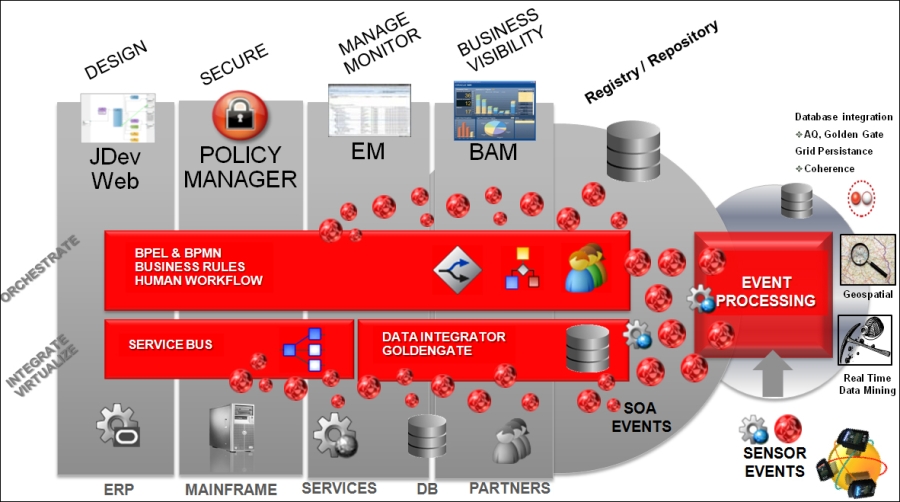
Before acting, the oracle verifies the event's authenticity and integrity. In decentralized oracle networks, multiple nodes may independently observe the same event to prevent single points of failure or malicious manipulation. The oracle checks cryptographic proofs or cross-references the data against other trusted sources. This step ensures that the AI agent receives accurate, tamper-proof information.
Once verified, the oracle triggers the execution layer. It writes the validated data to the blockchain or invokes a smart contract function that the AI agent monitors. This final step completes the loop, allowing the agent to process the new state and take action. The entire sequence happens in seconds, enabling real-time responsiveness for complex AI workflows.
This architecture shifts the paradigm from reactive queries to proactive responses. By leveraging event-driven design, AI agents can maintain state and react to dynamic environments without constant overhead. The result is a system that scales efficiently while maintaining the precision required for automated decision-making.
AI agents use live data for immediate decision-making
Event-driven oracles bridge the gap between static blockchain state and the dynamic real world by providing AI agents with immediate, verified data streams. Instead of polling for updates, agents subscribe to specific events, allowing them to react to market shifts, sensor readings, or user actions the moment they occur. This architecture reduces latency and ensures that automated decisions are based on the most current information available.
In trading environments, this immediacy is critical. An agent can monitor price feeds and execute trades across decentralized exchanges the instant a threshold is crossed. Oracle protocols like Threshold AI verify that the underlying data originates from reputable sources before triggering the smart contract, preventing exploits based on stale or manipulated information. This verification step is essential for maintaining trust in high-frequency automated financial operations.
Beyond finance, event-driven oracles support complex workflows in insurance and gaming. In parametric insurance, agents can automatically trigger payouts when oracles confirm weather data meets predefined criteria, such as wind speed exceeding a certain limit. Similarly, in gaming, oracles can verify random number generation or in-game asset ownership in real-time, ensuring fair play without manual intervention. The system processes these triggers efficiently, decoupling the data source from the execution logic.
Oracle Cloud Infrastructure (OCI) and similar enterprise platforms demonstrate how this pattern scales. By treating resource changes as events, systems can automatically adjust compute resources or trigger alerts based on live telemetry. When combined with Web3 oracle networks, this approach allows AI agents to operate with the same responsiveness as traditional cloud-native applications, but with the added security and transparency of decentralized verification.
Common setup mistakes
Building event-driven oracles requires precision. A single misconfiguration in your trigger logic can cause data desynchronization or security vulnerabilities. These pitfalls often stem from a misunderstanding of how off-chain events map to on-chain confirmations.
Ignoring latency gaps
The time between an off-chain event occurring and its on-chain confirmation is rarely zero. If your AI agent assumes immediate finality, it may act on stale data. This latency gap is particularly dangerous in high-frequency trading or real-time inventory management. You must build buffer zones into your event handlers to account for network congestion and block times.
Over-filtering events
Developers often apply aggressive filters to reduce noise, but this can inadvertently drop critical state changes. In Oracle Cloud Infrastructure (OCI), for example, events are structured messages indicating resource changes. If your filter logic is too rigid, you might miss a compartment change or an instance update that your AI agent needs to process. Start with broad ingestion and refine filters only after understanding the full event stream.
Weak security boundaries
Event triggers are attack vectors. If your oracle protocol does not strictly validate the source of an event, malicious actors can inject false triggers. Ensure that your event handlers verify signatures and origin before passing data to the AI agent. Treat every incoming event as untrusted until proven otherwise.
No comments yet. Be the first to share your thoughts!