

Event-Driven Oracles for Instant DeFi Liquidations and On-Chain Triggers

In the high-stakes arena of DeFi, where billions hinge on split-second decisions, traditional oracles often act like sluggish gatekeepers. They update prices on rigid schedules or only after big swings, leaving lending protocols exposed to delays that force overly cautious loan-to-value ratios. Enter event-driven oracles, the game-changers delivering real-time oracle triggers for instant DeFi liquidations and on-chain event triggers. Drawing from my 11 years tracking commodities and crypto correlations, I’ve watched supply shocks ignite trades; now, these oracles turn blockchain events into precise, automated responses, much like smart contracts fueled by reliable data feeds.

Picture this: a borrower’s collateral dips just enough to breach thresholds. With event-driven setups like RedStone’s Atom, zero-latency price updates hit the chain immediately, enabling protocols to liquidate positions faster than ever. This isn’t hype; it’s a structural upgrade slashing risks while unlocking higher leverage. Protocols can finally ditch conservative parameters, boosting capital efficiency without courting disaster.
Why Traditional Oracles Fall Short in Volatile Markets
Standard oracles, bless their periodic hearts, rely on fixed intervals or percentage-based pushes. In crypto’s wild swings, that means minutes or even seconds of lag between a price crash and liquidation signals. Lenders suffer bad debt; borrowers face MEV sandwich attacks. I’ve analyzed countless commodity-crypto links, and delays compound losses just like unhedged oil futures during a supply crunch.
The fallout? Protocols like Aave or Compound maintain liquidation thresholds at 80% LTV to buffer oracle delays, starving users of optimal yields. OEV exacerbates this; searchers exploit stale prices, pocketing millions in arbitrage. Estimates peg cumulative OEV losses above $500 million across DeFi. It’s a silent tax on innovation, one that blockchain oracle automation now dismantles.

RedStone’s Atom: Zero-Latency Backbone for Instant Liquidations
RedStone’s Atom stands out by pushing prices only when events demand it, achieving true push-based, event-driven feeds. No polling waste, no delays. When a position nears liquidation, Atom’s off-chain auctions capture OEV before on-chain publication, funneling value back to protocols. Borrowers pay less; lenders earn more. Genius, right?
Integration is seamless across EVM chains, no code rewrites needed. This scalability lets builders deploy DeFi liquidations with surgical precision. Chainlink’s liquidation-aware feeds complement this by preempting OEV attacks through proactive pricing tweaks. Together, they fortify lending against flash crashes, echoing how hybrid portfolio methods in commodities weather volatility.
Unlocking On-Chain Triggers for Prediction Markets and Beyond
Beyond lending, event-driven oracles power DeFi prediction markets and conditionals. Threshold AI Oracles from Supra verify real-world events cryptographically, turning elections or sports outcomes into on-chain triggers. Qubic’s Oracle Machines feed real-time data for sportsbooks and automations, while Hyperliquid’s event perps sidestep oracles altogether for pure prediction plays.
Raiku’s deterministic layer ensures perp DEX executions fire exactly when intended, no frontrunning nonsense. In my view, this convergence of AI, RWAs, and events redefines DeFi as truly reactive finance. Protocols gain stability; users, superior risk-adjusted returns. Commodities taught me events drive alpha; crypto’s oracle evolution proves it on-chain.
Prediction markets stand to gain the most from this shift. Platforms like those powered by Supra’s Threshold AI Oracles don’t just fetch prices; they verify fuzzy real-world happenings-say, a sports score or election result-and pipe them straight into smart contracts as tamper-proof on-chain event triggers. No more disputes over outcomes; payouts trigger automatically, settling bets in blocks. I’ve seen commodities futures thrive on event resolution; DeFi prediction markets now mirror that precision, often outperforming polls with crowd-sourced, real-time price discovery.
Ethereum Technical Analysis Chart
Analysis by Olivia Martinez | Symbol: BINANCE:ETHUSDT | Interval: 1h | Drawings: 7
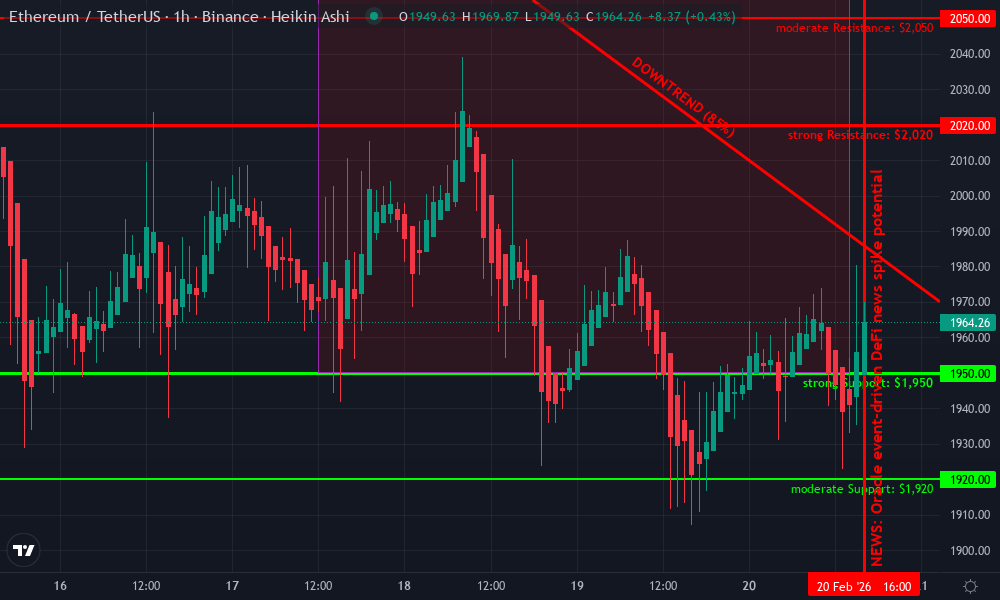
Technical Analysis Summary
Aggressively mark the dominant downtrend with a thick red trend_line from the peak at 2026-02-17T12:00:00Z ~$2100 down to recent lows around 2026-02-21T16:00:00Z ~$1950, signaling continuation unless broken. Draw horizontal_lines at key support $1950 (strong) and resistance $2020/$2050. Use fib_retracement from high $2100 to low $1950 for potential bounce zones at 38.2% ($2010) and 50% ($2025). Rectangle the consolidation zone mid-week around $1980-$2020. Long_position entry at $1960 with stop below $1950, target $2050. Short_position if breaks $1950 targeting $1900. Arrow_mark_up on recent green Heikin Ashi reversal candle. Callouts on volume spikes during dumps. Vertical_line on potential news event at 2026-02-20. In my aggressive style, we’re hunting that bold reversal play!
Risk Assessment: high
Analysis: High volatility in ETH with aggressive setup, but downtrend intact – suits my high tolerance
Olivia Martinez’s Recommendation: Go long aggressively on bounce, target $2050, risk high for bold rewards!
Key Support & Resistance Levels
📈 Support Levels:
-
$1,950 – Recent swing low with volume support
strong -
$1,920 – Psychological and prior test level
moderate
📉 Resistance Levels:
-
$2,020 – Immediate overhead from prior rejection
strong -
$2,050 – Mid-channel resistance
moderate
Trading Zones (high risk tolerance)
🎯 Entry Zones:
-
$1,960 – Aggressive long on Heikin Ashi reversal with volume
high risk -
$1,930 – High-risk dip buy if support holds
high risk
🚪 Exit Zones:
-
$2,050 – Profit target at resistance confluence
💰 profit target -
$1,940 – Tight stop below support
🛡️ stop loss
Technical Indicators Analysis
📊 Volume Analysis:
Pattern: Increasing on downside, spike on recent green candle
Bearish volume drying up, bullish divergence hint
📈 MACD Analysis:
Signal: Bearish crossover but histogram contracting
Potential bullish divergence emerging
Applied TradingView Drawing Utilities
This chart analysis utilizes the following professional drawing tools:
Disclaimer: This technical analysis by Olivia Martinez is for educational purposes only and should not be considered as financial advice.
Trading involves risk, and you should always do your own research before making investment decisions.
Past performance does not guarantee future results. The analysis reflects the author’s personal methodology and risk tolerance (high).
Take Hyperliquid’s event perps, backed by Kalshi. They bypass oracles entirely for binary outcomes, but when paired with real-time oracle triggers, unlock composability across DeFi. Imagine a perp on ‘Will BTC hit $100K by EOY?’ resolving via oracle-fed data, then triggering collateral liquidations or yield boosts elsewhere. Qubic’s Oracle Machines extend this to sportsbooks, where a goal flips markets instantly, automating payouts without human intervention. These aren’t gimmicks; they’re blockchain oracle automation at scale, compressing event-to-action timelines from minutes to milliseconds.
Capturing OEV: Redirecting Millions Back to Protocols
Atom’s OEV capture mechanism deserves a spotlight. In traditional setups, MEV bots snatch value from stale prices during liquidations-up to $500 million drained historically. Atom flips the script: off-chain auctions let protocols bid for optimal prices before on-chain commitment. That surplus? It subsidizes fees or juices APYs. Protocols integrating this report 20-30% better capital efficiency, per early adopters. Chainlink’s proactive feeds add another layer, tweaking prices to foil exploits preemptively. From a portfolio lens, it’s like hedging supply shocks before they hit; strategic, not reactive.
Scalability seals the deal. Event-driven oracles like those from EventOracles. com deploy across EVM chains without refactoring. Drop in a feed, tweak thresholds, and watch DeFi liquidations hum at peak efficiency. Raiku’s deterministic execution layer takes it further for perps, guaranteeing order timing amid congestion. No more slippage roulette.
Developers, this is your cue. In volatile regimes-commodity squeezes or crypto dumps-events dictate winners. Traditional polling wastes gas; push-based oracles align incentives, capturing alpha where it hides. My hybrid allocation playbook always prioritized triggers over trends; now, on-chain equivalents empower builders to do the same.
The Multi-Chain Edge: From Lending to Cross-Chain Automations
Multi-chain dominance amplifies everything. Atom’s plug-and-play spans Ethereum, Arbitrum, Base-you name it. Pair with API3’s first-party feeds for insurance or gaming, and suddenly, a weather event triggers parametric payouts or game-state shifts. DeFi liquidation protocols evolve into full-spectrum risk engines, maintaining stability sans overcollateralization. Risks? Minimal, if you vet oracle decentralization. Supra and RedStone score high on redundancy, cryptographically signing data from multiple nodes.
Looking ahead, AI integration via Threshold oracles will parse unstructured events-news headlines, social sentiment-into verifiable inputs. Prediction markets on exchange bankruptcies, as Sparkco AI forecasts, could size into billions by 2025. EventOracles. com leads here, tailoring event-driven oracles for exactly these use cases. Builders get unmatched speed; traders, edge. Commodities volatility honed my strategies; blockchain’s oracle renaissance sharpens them for Web3.
Embrace this evolution. Ditch laggy feeds for triggers that react like pros. Your protocols-and portfolios-will thank you when the next shock hits.